Couple lines and child lines
Two kinds of line form the framework of a genogram: the horizontal couple line between two people and the vertical child line from a couple down to the children. Both show their type in the stroke and their years as a label.
The couple line
A marriage is a solid line, a partnership – that is, living together without a marriage certificate – a dashed one, an engagement a dashed one with the note “engaged”, and an affair a dotted line. The line shows what you have entered: “m. 1970”, “since 1995”, “sep. 1995”, “div. 1997”.
There are two symbols for the end of a relationship that are the same everywhere: one slash through the couple line means separated, two slashes divorced. The line itself remains – the connection did exist, after all, and it explains the children who came from it.
If a person had several partnerships in succession, they stand side by side: the earliest on the left, the current one on the right. This order helps because the children can then also stand in birth order without lines crossing. You do not have to think about this while drawing: the “Arrange” button puts partners and children in this order when you press it.
The child line
From the middle of the couple line, a line runs down to the sibling bar, and from there a separate line branches off to each child. Its stroke says how the child belongs to these parents: solid for a biological child, dashed for an adopted one, dotted for a foster child. Here too, the textbooks differ – some draw adoption dotted and fostering with short dashes. That is why the legend Genofeld creates always states which stroke means what here.
The children stand from left to right by year of birth, the eldest on the left. A child can belong to two parent links: to the biological parents and to the adoptive or foster parents. Two lines then lead to this child, each with its own stroke and at its own place on the top edge; you add the second link in the “Details” panel under “Parents”. This is exactly the case that is hard to draw on paper – and it is everyday work in social work.
A single parent does not need a workaround: the child line then runs down from that one person. Twins and multiple births branch off diagonally from one point; for identical ones, a crossbar is added between the two lines. You record them by selecting the siblings and choosing “Record as multiple birth” in the details.
Who lives together: the household
Who is related to whom does not yet say who lives under one roof. That is what the household is for: a dotted outline around everyone who lives together – a single one where possible, even across two generations; only if it would otherwise include someone who does not belong does each generation row get its own. Behind it lies a light tint in the household’s colour. If the outline splits into two parts, both carry the same tint – so it stays visible what belongs together. The household’s name appears in the legend. For a printout without colour, each household instead gets its own line pattern on its outline (the “For black-and-white printing” switch). In blended families, this is the detail that makes the picture understandable in the first place. An example is the Blended family template.
The symbols at a glance
| Name | Symbol |
|---|---|
| Marriage | 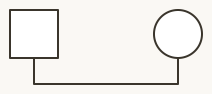 |
| Partnership |  |
| Engagement | 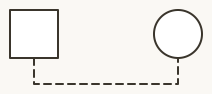 |
| Affair |  |
| Separated | 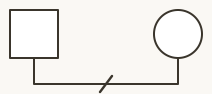 |
| Divorced | 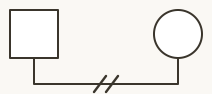 |
| Several partners | 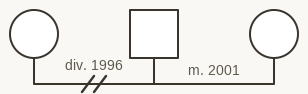 |
| Biological child |  |
| Adopted child | 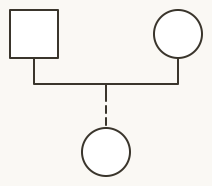 |
| Foster child |  |
| Twins, fraternal |  |
| Twins, identical | 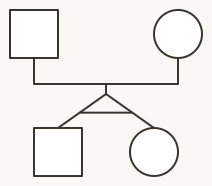 |
| Single parent | 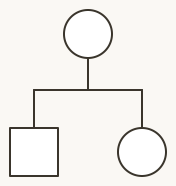 |
| Two sets of parents |  |
| Household | 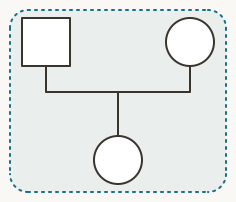 |
How to show the way people relate to each other is described under Relationship lines. The shapes of the people themselves are explained in People in a genogram.