Example: adoption and a foster child
When a child does not grow up with their birth parents, both sides belong in the genogram: the family the child lives in and the family the child comes from. This template shows what that looks like with two child lines.
What the template is for
For child and youth services, family support and work with foster families – and for anyone learning how to draw adoption and fostering properly. It shows the case where a child belongs to two sets of parents, and makes it visible that a dotted line means a foster relationship, not less care.
What you can see
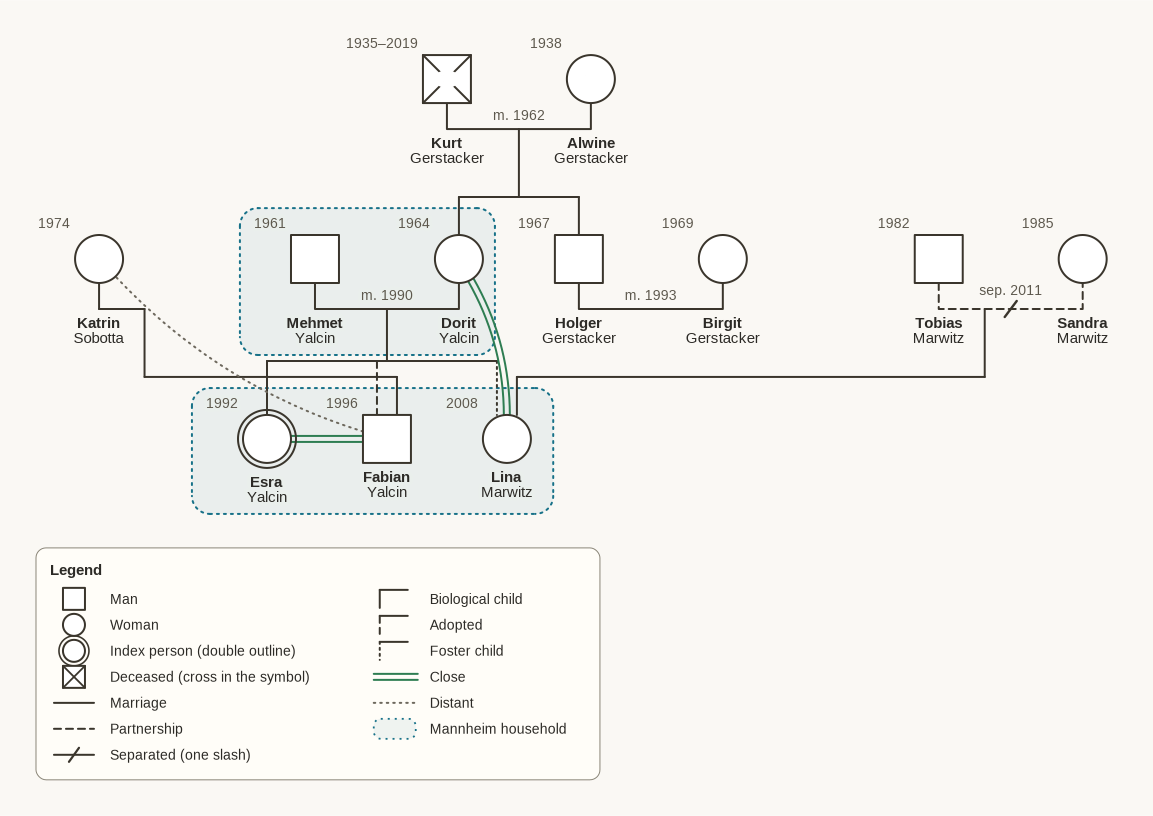
The family is invented. Dorit Yalcin, née Gerstacker (born 1964, a nursery teacher in Mannheim), married Mehmet Yalcin (born 1961, a master mechanic) in 1990; for him, the background noted is that the family came from Kayseri in 1972. Dorit’s parents are Kurt Gerstacker (1935–2019), a baker, and Alwine Gerstacker, née Rehbein (born 1938), a bakery assistant; Dorit’s brother Holger (born 1967, a bus driver) is married to Birgit, née Olbrich (born 1969, a medical assistant).
Dorit and Mehmet’s household includes three children, and each hangs from a different type of line. Esra (born 1992, a student) is the biological child and the index person – solid line, double outline. Fabian (born 1996, an electronics technician) was adopted at the age of two: a dashed line leads to Dorit and Mehmet, a solid one to his birth mother Katrin Sobotta (born 1974). Lina (born 2008, a pupil) is a foster child: a dotted line to Dorit and Mehmet, a solid one to her birth parents Tobias and Sandra Marwitz, whose partnership ended in 2011.
The dotted outline shows the household in Mannheim with Dorit, Mehmet, Esra, Fabian and Lina. Three relationship lines are drawn: Lina and Dorit are close, Fabian and his birth mother distant, Esra and Fabian close. The chronology has the two events everything turns on: Fabian is adopted in 1998, and Lina joins the family in 2014.
What to look out for in your own genogram
- Draw both sets of parents. A child may have two child lines. Leaving out the birth parents makes the picture wrong – even if there is no contact.
- Do not mix up the line types. In Genofeld, adopted is dashed and fostered is dotted. Other notations do it the other way round, so the legend goes with the drawing – especially when it goes into a case file.
- Record the year. When a child came into the family is often the most important detail. As an event in the chronology, it appears with the child’s age.
- Keep household and kinship apart. The outline says who lives together; the lines say who belongs to whom.
- Describe with restraint. Often little is known about the birth parents, and some of it only by hearsay. What is uncertain stays uncertain – what has been told can be entered as a trait with the status “suspected”.
The line types are explained in Couple lines and child lines, the symbols for traits in Illness, addiction and custom traits. What else to bear in mind in casework is described under Genograms in social work.